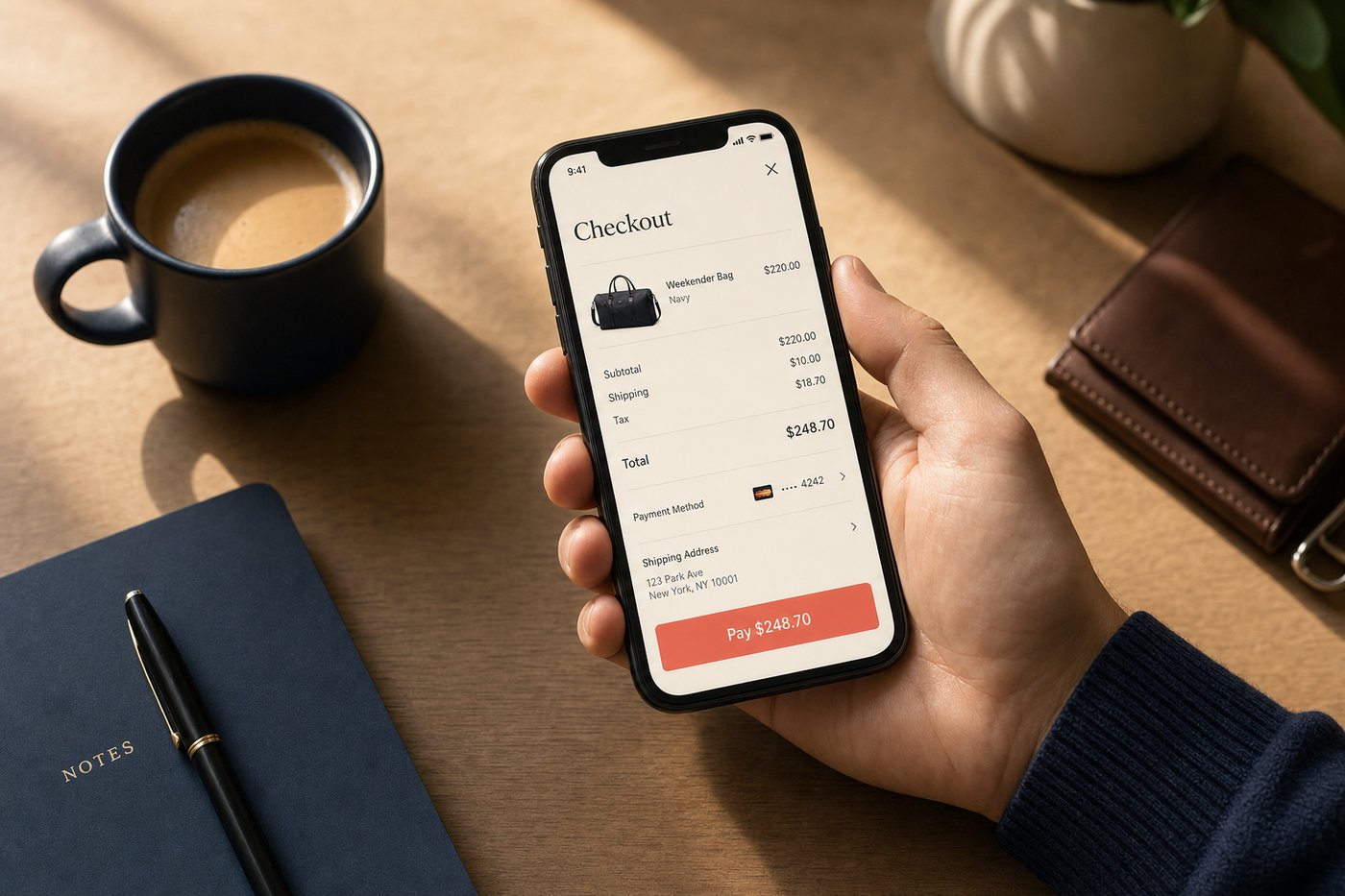
The average e-commerce checkout page asks you to fill in eleven form fields and complete more than five discrete steps before you can confirm a purchase. On a phone, with a small keyboard and a wandering attention span, that is enough friction to send roughly seven out of ten carts into abandonment. Shop Pay was built as a direct answer to that problem — and the numbers suggest it works. Shopify's data shows checkouts through Shop Pay convert at rates up to 50 percent higher than standard guest flows, and up to 10 percent higher than other accelerated checkout options. This article explains exactly how that happens.
What Shop Pay Is
Shop Pay is the accelerated checkout system built into both the Shop mobile app and the Shop Pay button that appears on millions of Shopify-powered storefronts. At its core, it is a digital wallet: you enter your email address, shipping address, and payment details once, and the system stores that information securely so you never have to enter it again at any participating store.
The service launched in 2017 as Shopify Pay and was rebranded to Shop Pay in 2020 alongside the broader Shop app launch. As of 2024, it has more than 150 million registered users worldwide and is accepted at over two million merchants — every business running on Shopify's platform, plus select partners on Facebook, Instagram, and Google. For a fuller picture of everything the Shop app does beyond checkout, see our Shop App pillar review.
It is free to use as a shopper. There are no fees, no subscription requirements, and no minimum spend. The service earns its revenue through the merchant side of the transaction, which is already baked into Shopify's platform fees.
How the Checkout Flow Works
The Shop Pay checkout sequence has been refined to its minimum viable steps. Here is what happens in practice:
Step 1 — Email recognition. When you reach checkout at a participating store, you enter your email address. If that address is associated with a Shop Pay account, the system recognizes you and sends a six-digit verification code to your phone.
Step 2 — One-tap confirmation. You enter the verification code (or approve via biometric on the Shop app), and your saved name, shipping address, and payment card are automatically populated into the checkout fields. You review the order summary.
Step 3 — Place order. A single tap — confirmed with Face ID, Touch ID, or passcode — places the order. The entire sequence typically runs in under ten seconds from the email field to order confirmation.
Shopify estimates this cuts checkout time by approximately 20 seconds per transaction compared to manual entry. Across the volume of purchases made through the network, that aggregate time saving is substantial. Investopedia's analysis notes that Shop Pay boosts mobile conversion rates by 1.91x — a figure that reflects how decisively speed and simplicity drive completion.
The system supports up to ten saved payment cards and up to twenty shipping addresses, which accommodates the real complexity of how people actually shop — different cards for different purposes, home and work and gift addresses.
Shop Pay Installments: Buy Now, Pay Later
Beyond one-tap checkout, Shop Pay includes an integrated Buy Now, Pay Later option called Shop Pay Installments, powered in partnership with Affirm. This is one of the most generous BNPL implementations available in the US market.
Eligible purchases range from $35 to $30,000. That upper limit is exceptional — most BNPL services cap out at a few thousand dollars, making them unsuitable for larger purchases like furniture, bicycles, or electronics. Shop Pay Installments handles all of it.
Two plan structures are available:
- Pay in 4. Split the purchase into four equal payments, due every two weeks. This plan carries 0 percent APR — no interest, no fees — for purchases under a certain threshold. It is the most straightforward option for everyday purchases.
- Monthly installments. For larger purchases or longer terms, monthly plans are available for up to 24 months. APRs on monthly plans range from 0 percent to 36 percent depending on creditworthiness and plan length. Affirm conducts a soft credit inquiry to determine eligibility, which does not affect your credit score.
There are no late fees on installment plans, which distinguishes Shop Pay Installments from some competing BNPL services. For a broader comparison of BNPL options, see our Klarna vs Affirm vs Afterpay comparison and our BNPL explained guide.
Shop Cash: Built-In Rewards
Every eligible Shop Pay purchase earns 1 percent back in Shop Cash — the app's proprietary rewards currency. Shop Cash accumulates in your Shop wallet and can be applied to any future purchase at any participating store. There is no minimum redemption threshold, and Shop Cash does not expire on a short timeline, making it genuinely usable rather than aspirational.
Shop Offers periodically boost the rewards rate at specific merchants — sometimes to 5 percent or more — which can make Shop Cash accumulate meaningfully for frequent shoppers. The rewards rate is not the highest available among shopping apps, but its simplicity and breadth of redemption make it competitive. Compare this to what you would earn with a general-purpose credit card rewards program: the 1 percent baseline is roughly on par, and the zero-effort enrollment is a genuine advantage.
Where Shop Pay Works
The primary context is Shopify-powered stores, which number in the millions and span virtually every product category. But Shop Pay's footprint has expanded beyond the Shopify platform. The checkout button is also available on:
- Facebook and Instagram. Merchants selling through Meta's commerce integrations can offer Shop Pay as a checkout option, which means the accelerated experience extends into social media shopping.
- Google. Shop Pay is available through Google's shopping surfaces, including the Shopping tab and Buy on Google integrations.
- In-store. Some merchants accept Shop Pay via QR code at physical retail locations, extending the digital wallet experience into brick-and-mortar settings.
The checkout button is not yet as universally accepted as PayPal or Apple Pay — both of which appear on a wider range of non-Shopify sites. But within its network, it is among the fastest and most consistent checkout experiences available.
Security at Checkout
Shop Pay is PCI-DSS Level 1 compliant — the highest certification tier in the payment card industry, the same standard used by major banks and card networks. Payment data is encrypted end-to-end and stored on Shopify's secure servers, never transmitted in plain text and never stored on your device or exposed to the merchant in raw form.
Two-factor authentication is built into every transaction: the verification code sent to your phone serves as the second factor beyond your email address. For returning users in the Shop app, biometric confirmation (Face ID or Touch ID) replaces the code entry, which is both faster and equally secure. For a detailed look at the security architecture, see our Shop App security review.
How It Compares to Rivals
Against Apple Pay, Shop Pay's advantage is the cross-merchant memory: Apple Pay also uses biometric confirmation and device-level security, but it does not store shipping details in a way that populates checkout forms across different websites. Shop Pay fills both payment and shipping fields, which is more comprehensive. See our Shop Pay vs Apple Pay comparison for a full breakdown.
Against PayPal's One Touch, Shop Pay's conversion data is stronger within the Shopify ecosystem, but PayPal's acceptance is broader. If you shop across many different platforms — some on Shopify, some not — a combination of both services covers more ground. Our PayPal vs Shop Pay comparison explores the trade-offs in detail.
Against other BNPL services like Klarna and Afterpay, Shop Pay Installments competes well on the upper limit of purchase size and on the absence of late fees. Klarna and Afterpay both have more developed shopping discovery networks, but Shop Pay's integration into the checkout flow is tighter and requires fewer steps.
What We'd Love to See Next
The one area with obvious room for growth is acceptance. Shop Pay is exceptional within the Shopify universe, but the broader web still has many retailers — particularly large brands with proprietary platforms — where it is unavailable. An open API or white-label partnership program that brought Shop Pay's checkout experience to non-Shopify merchants would be a significant expansion of its value. Shopify has signaled interest in exactly this kind of growth, and the infrastructure is already capable of handling it.
Bottom Line
Shop Pay is the most capable accelerated checkout experience available for shoppers at Shopify-powered stores. The combination of one-tap payment, pre-populated shipping, biometric confirmation, integrated BNPL, and passive rewards into a single flow is genuinely impressive — and the conversion data confirms that real shoppers find it meaningfully better than the alternatives. If you shop at independent brands and direct-to-consumer retailers, enabling Shop Pay is one of the highest-value, lowest-effort improvements you can make to your online shopping experience.
For the complete picture of the Shop app ecosystem, return to our Shop App definitive guide.