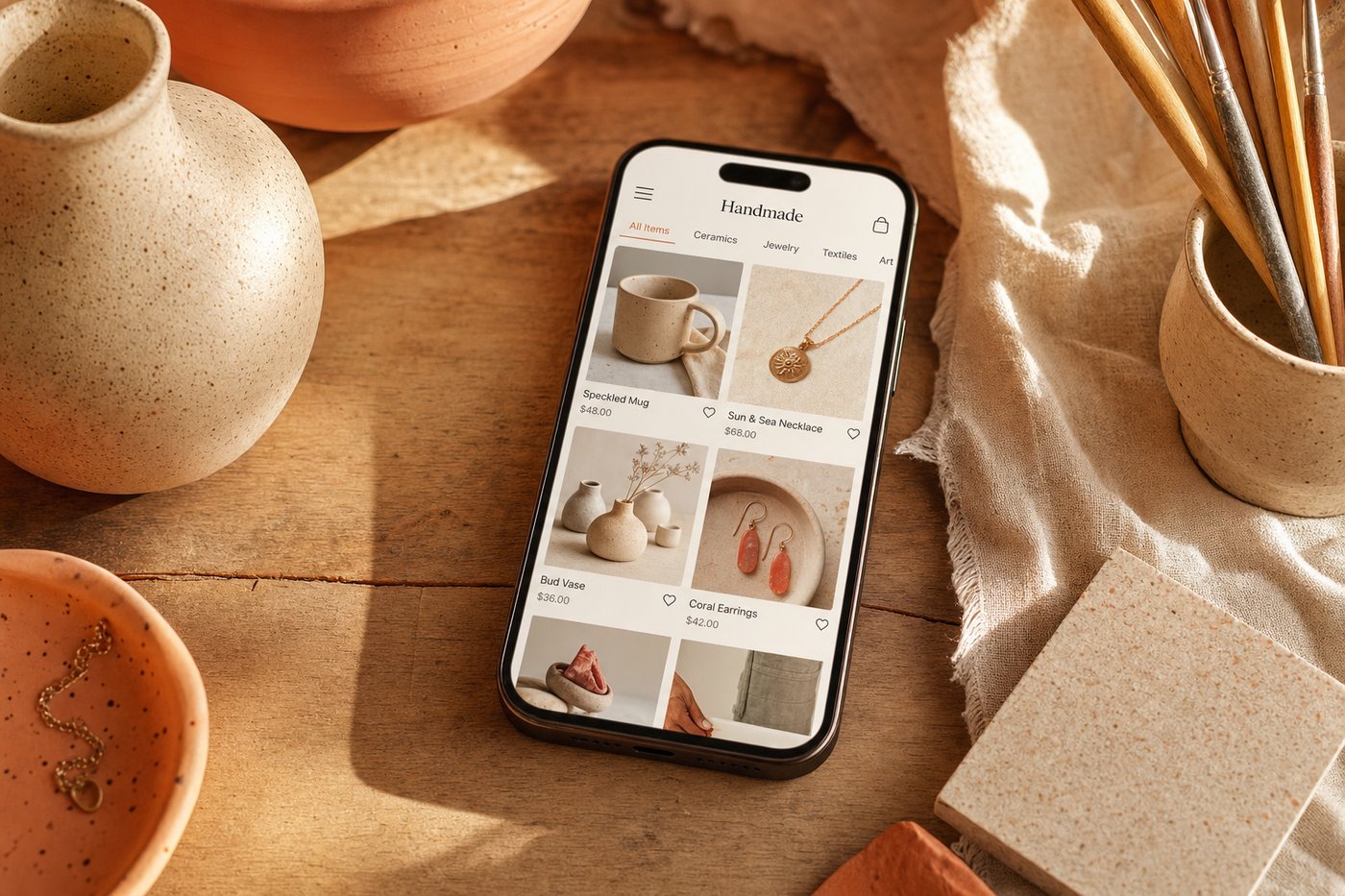
There is a particular kind of shopping that Amazon has never quite figured out: the search for something genuinely one-of-a-kind. A hand-thrown ceramic mug from a small studio in Vermont. A custom leather wallet stamped with initials. Vintage linen curtains sourced from European estate sales by a seller who has been doing this for fifteen years. For this kind of buying — where the identity of the maker matters and the item cannot simply be reordered from a warehouse — Etsy remains the dominant address in US mobile commerce. The Etsy consumer app is the primary interface through which its 31.7 million active buyers access an inventory of 45 million items from 1.9 million active sellers worldwide.
What it is
Etsy is a global marketplace for handmade, vintage, and craft-related goods, operated by Etsy, Inc., which launched the marketplace in 2005 and has grown it into a publicly traded platform serving buyers and sellers in more than 90 countries. The consumer mobile app — titled "Etsy: Shop Home, Style & More" on iOS and Android — covers product discovery, checkout, order tracking, seller messaging, favorites and collections, gift lists, and occasion-based shopping curation.
A separate companion app, Etsy Seller (launched in its current form in July 2022), handles the seller-side workflow: listing management, order processing, buyer messaging, shop analytics, and mobile shipping label purchasing. This review focuses on the consumer app, though the seller app's quality is relevant context: strong seller tools support a more active and engaged seller community, which ultimately benefits buyers.
The App Store listing for the consumer app shows 57 million ratings with a 4.9/5 star average — a signal of both enormous usage scale and broadly positive reception over many years of updates. Etsy's marketplace has 45 million items listed across categories spanning jewelry, home décor, clothing, art prints, vintage goods, craft supplies, personalized gifts, wedding accessories, and more.
Etsy occupies a structurally distinct niche in the commerce app landscape. It is not competing with Amazon or Walmart on price, speed, or catalog breadth. Its inventory is irreplaceable in the sense that many individual listings exist nowhere else, and that scarcity — of specific items, specific sellers, specific aesthetics — is the product's core value proposition. The mobile app is the tool that makes that idiosyncratic inventory discoverable and purchasable from anywhere.
How it works
Downloading and setting up the Etsy app requires an account (email address or social sign-in via Google or Apple), with optional addition of a shipping address and saved payment method to streamline checkout. Once configured, the home screen presents a personalized discovery feed of items drawn from your browsing history, saved searches, favorited shops, and algorithmic curation — a Pinterest-adjacent browsing experience that rewards exploratory scrolling.
Search is Etsy's most distinctive UX element relative to mass-market shopping apps. Because each listing is written and photographed by an individual seller rather than populated from a standardized catalog, the search results are inherently more varied and require more contextual interpretation. Etsy's algorithm surfaces items based on keyword relevance in the listing title and description, seller rating and review volume, listing quality signals, and recency. Users can filter results by price range, ship-from location, free shipping availability, customization options, and item type (handmade, vintage, or craft supplies).
Image search is available through the camera icon in the search bar: you can photograph an object in the physical world or upload an image to find visually similar items on Etsy. This feature is particularly useful for shoppers who see a design element they want to replicate — a specific type of pendant, a furniture silhouette, a fabric pattern — and want to find a handmade version made by an Etsy seller.
Checkout on Etsy accepts major credit and debit cards, PayPal, Apple Pay, Klarna, and Etsy gift cards — a broad payment menu for a specialty marketplace. Orders are placed with individual sellers rather than through a centralized Etsy warehouse, meaning production times, shipping speeds, and tracking quality vary by seller. Post-purchase communication with sellers happens through the app's integrated messaging feature, which buyers use frequently for custom order specifications, shipping timelines, and post-delivery questions.
Key features
- Handmade, vintage, and craft marketplace: Access to 45 million items from 1.9 million active sellers across categories including jewelry, home décor, clothing, art, vintage goods, craft supplies, personalized gifts, and wedding items. The inventory itself is the product — the reason to choose Etsy over any competing app is the existence of items that simply cannot be found elsewhere.
- Image search: Camera-based visual search lets users find items based on a photo or image upload. Etsy's image search is oriented toward style and form matching rather than barcode or QR scanning, making it useful for creative shoppers who have a visual idea of what they want but not the words to describe it precisely.
- Favorites and collections: Items can be saved to lists organized by occasion, room, recipient, project, or any custom label. Collections can be shared with others, which makes Etsy useful for collaborative gift planning — a wedding registry, a baby shower gift pool, or a joint home decorating project.
- Gift guides and occasion shopping: The app surfaces curated gift guides for occasions including birthdays, weddings, housewarmings, graduations, and major holidays, organized by category and price range. These guides serve as a useful discovery starting point for shoppers who know the occasion but not the specific item, and they are updated seasonally.
- Seller messaging: Direct in-app chat with sellers for custom order requests, shipping inquiries, design discussions, and post-purchase follow-up. This channel is well-used and typically faster than email for time-sensitive questions. The ability to communicate directly with the person making your item is a structural differentiator from mass-market apps where there is no equivalent pathway.
- Multi-payment checkout: Cards, PayPal, Apple Pay, Klarna, and Etsy gift cards are all supported at checkout — a broader payment menu than many specialty marketplace apps offer and a level of payment flexibility that accommodates the range of buyer preferences on a global platform.
- Order tracking and delivery updates: The app tracks in-transit orders and delivers push notification status updates as shipments progress. Because Etsy orders ship directly from individual sellers using their own carrier accounts, tracking availability depends in part on whether the seller purchased a trackable shipping label, but the app surfaces all available tracking data in one view.
Who it's for
Etsy's mobile app serves several overlapping shopper profiles. The most devoted user is someone who buys gifts regularly — for weddings, birthdays, baby showers, housewarmings, and holidays — and who values personalized or one-of-a-kind items over generic retail choices. For this shopper, Etsy is the first stop rather than the fallback, and the app's collections and gift guide features directly support this use pattern.
The second major audience is the craft enthusiast who buys supplies — yarn, fabric, embroidery floss, beads, leather, woodworking materials — and who values the variety and quality of small-batch or specialty suppliers over the commodity versions available on Amazon or Walmart. Etsy's craft supplies category is deep and particularly well-used by makers who need specific materials that are not stocked at chain craft stores.
Home decorators looking for items that will not appear in every other apartment or house — handmade ceramics, artisan candles, hand-blocked textiles, vintage prints — use Etsy as a design tool as much as a shopping platform. The image search and collections features reinforce this discovery-oriented, aesthetically driven use pattern, where the goal is finding something specific to a personal vision rather than fulfilling a standard product need.
Etsy is less suited to shoppers who prioritize fast and guaranteed shipping timelines, standardized product quality across listings, or the lowest possible price on commodity goods. Production and shipping windows on handmade items vary significantly by seller, and price-conscious shoppers will find comparable mass-produced alternatives elsewhere at lower cost. The Etsy premium is essentially the premium of originality, craftsmanship, and direct-from-maker purchasing — real value for some shoppers, less relevant for others.
Strengths
Etsy's inventory depth is its most defensible and structurally irreplaceable advantage. No competing platform approaches 45 million handmade, vintage, and customizable items from nearly 2 million individual sellers. This is not a gap that can be bridged by catalog expansion alone; it requires the seller community, the trust infrastructure Etsy has built over two decades, and the specific positioning that attracts makers to list there rather than elsewhere. The inventory's uniqueness is the product.
The app's discovery experience is genuinely well-designed for the browsing behavior that characterizes Etsy shopping. The combination of personalized feeds, image search, curated collections, and occasion-based gift guides creates an interface that rewards exploration and improves with use — which matches how Etsy buyers actually behave on the platform. This is not a utilitarian product-search experience; it is a discovery experience, and the app reflects that with appropriate design choices.
Seller messaging is a functional differentiator that mass-market apps structurally cannot replicate. Being able to chat directly with the person making your order — to request a color variation, confirm a size, ask whether a listing can be completed by a specific date, or report a quality issue — adds a layer of customization and accountability that changes the nature of the transaction. Many Etsy buyers return repeatedly to sellers they have built a history with, which creates loyalty relationships that benefit both sides.
Payment flexibility is above average for a specialty marketplace. Supporting Apple Pay, PayPal, Klarna, and multiple card types at checkout reduces friction for the diverse global buyer base Etsy serves, and the Klarna integration in particular opens the door to BNPL splitting on larger handmade items — custom furniture, fine jewelry, original art — that might otherwise require a buyer to wait until they have saved the full amount.
Things to watch
The handmade and small-batch nature of Etsy's inventory creates meaningful variability in quality and consistency that is structural rather than correctable. Individual sellers operate at different scales, with different quality standards, different photography skills, and different levels of professionalism. App reviews frequently cite inconsistency between listing photos and received items as a concern, and Etsy's buyer review system, while helpful for filtering sellers, cannot eliminate this variability across 1.9 million active sellers. Reading a seller's reviews carefully before purchasing — especially recent reviews on the specific product type you are buying — is advisable.
Shipping times are inherently less predictable than on Amazon or Walmart. Handmade items often require production time before shipping, and production windows stated in listings are estimates rather than guarantees. Sellers operating as solo makers may be slower during busy periods (holidays, craft fair seasons) than their stated timelines suggest. Shoppers with a firm delivery deadline should message sellers in advance to confirm current turnaround time, not rely solely on the listing estimate.
Search quality and marketplace integrity have drawn increasing scrutiny in recent years. As Etsy's scale has grown, the ratio of genuinely handmade items to print-on-demand and reseller listings has become a topic of concern among long-time Etsy buyers and sellers. Etsy has implemented seller disclosure requirements for handmade production assistance, but the challenge of curation at the scale of 45 million listings and 1.9 million sellers is real and ongoing. Filtering to established sellers with strong review histories helps, but it is not a complete solution.
Transaction fees on the seller side — which flow into the pricing that buyers see — include a 6.5% transaction fee, listing fees, and optional advertising charges. These costs are reflected in Etsy item prices that often appear higher than mass-produced alternatives. The premium is real and reasonable for genuinely handmade or vintage goods, but shoppers should calibrate expectations accordingly rather than comparing Etsy prices to Amazon or Walmart pricing as if they were equivalent products.
How it compares
Etsy's most direct competitor in the mobile commerce space is Amazon Handmade — Amazon's marketplace for artisan goods launched within its existing infrastructure. The two differ significantly in scale, culture, and seller expectations. Etsy's seller community is larger, more established, and more oriented toward independent craft and vintage; Amazon Handmade benefits from Prime shipping infrastructure and Amazon's massive buyer base but has struggled to match Etsy's seller density in many categories and the discovery-oriented browsing experience that Etsy's app provides. Our Etsy vs Amazon Handmade comparison examines both platforms across the dimensions that matter most for buyers of handmade goods.
For shoppers who order from Etsy, Amazon, and other retailers simultaneously, the Shop app is worth noting: it consolidates order tracking across multiple stores into a single feed, which is practically useful when you have several Etsy orders in production alongside purchases from other platforms. Our order tracking apps guide explains how these consolidation tools work and which shoppers benefit most from them.
Etsy accepts Klarna at checkout, which means shoppers curious about splitting a larger purchase — a piece of original art, a custom piece of furniture — can consult our Klarna review for details on how the Pay in 4 structure works and what to watch for on terms. The best shopping apps of 2026 list provides broader competitive context for where Etsy fits relative to both specialty and general-purpose commerce apps.
Bottom line
The Etsy mobile app is the right tool for a specific and genuinely underserved kind of shopping — one that values originality, craft, and direct maker relationships over speed, price predictability, and standardized logistics. Within that niche, Etsy is the dominant platform by a substantial margin, and the app reflects two decades of work on making a non-standardized marketplace discoverable and usable on a small screen. The caveats are inherent to the model rather than correctable by the app: quality variability across 1.9 million sellers, shipping timelines that require active management for deadline-sensitive purchases, and a search experience that demands more patience and interpretive effort than mass-market alternatives. For shoppers who are specifically looking for something that cannot be found anywhere else, those trade-offs are generally worth accepting. For a direct comparison of the two largest handmade marketplaces, our Etsy vs Amazon Handmade comparison is the most useful next read.