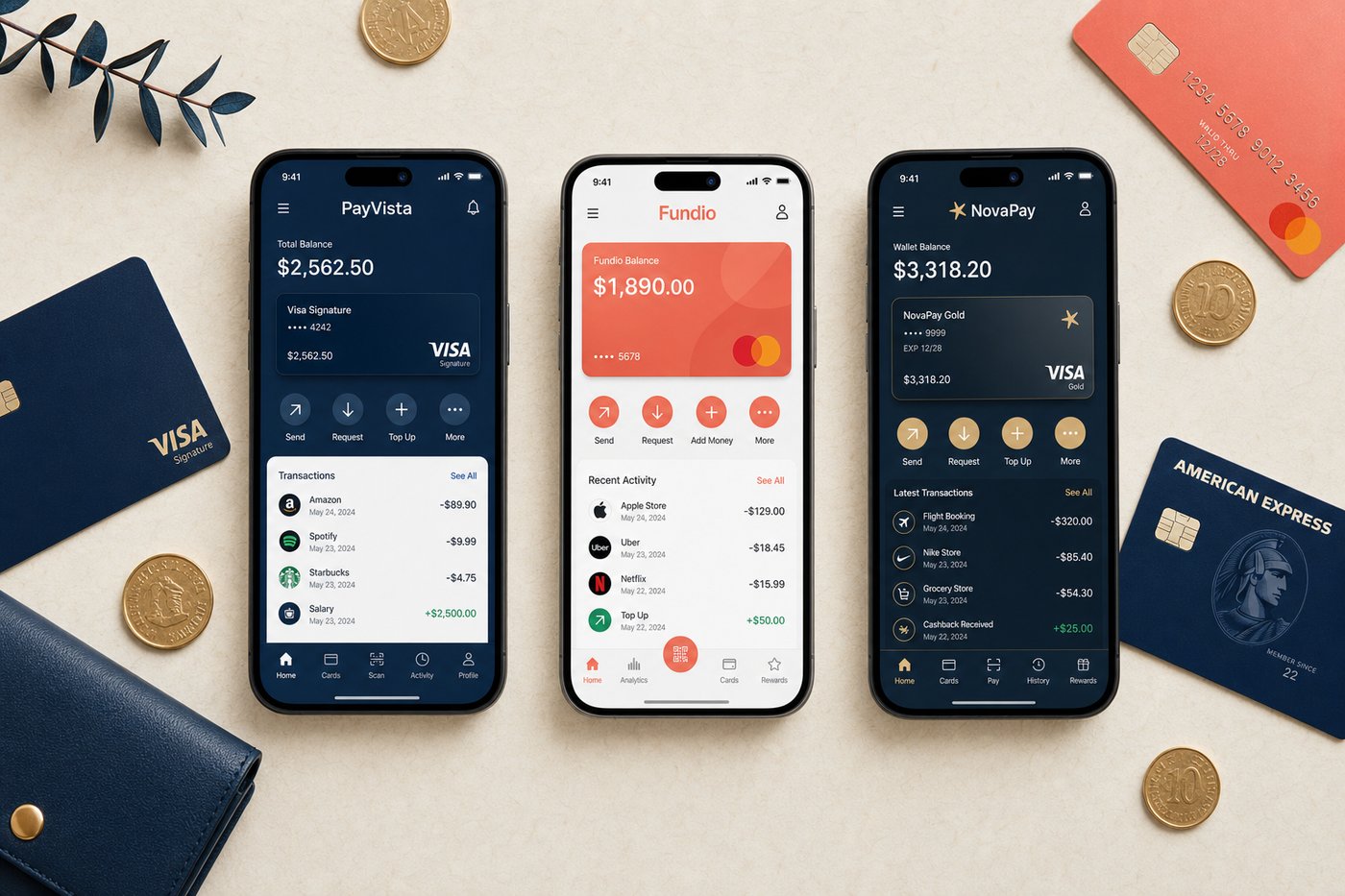
A mobile wallet is only as useful as the places it works and the friction it removes. In the US market in 2026, the leading mobile wallets converge on the same core technology — NFC tap-to-pay, tokenization, biometric authentication — while diverging meaningfully on ecosystem integration, reward programs, cross-platform availability, and the range of non-payment items (loyalty cards, transit passes, IDs) they can store. Choosing among them is less a question of which is objectively best and more a question of which fits how a particular shopper actually lives and pays.
The market has also grown more differentiated. The device-native wallets (Apple Pay, Google Wallet, Samsung Wallet) remain strongest for in-store contactless payments. The checkout-acceleration services (Shop Pay, PayPal) remain strongest for online purchases. And the peer-to-peer wallets (Venmo, Cash App) have added purchase capabilities that blur the old category lines. Understanding what each wallet does best before committing to a configuration avoids the frustration of reaching for the wrong tool at the wrong moment.
How we chose
We evaluated each wallet on: acceptance breadth at US merchants and online retailers, security architecture including tokenization and biometric requirements, ease of setup and card enrollment, rewards or cashback programs, cross-platform availability, the quality and usefulness of the companion app, and how each handles disputes and fraud. Statistics are drawn from published company disclosures and independent research.
The best mobile wallets for US shoppers in 2026
1. Apple Pay — Best for iPhone users and in-store contactless
Apple Pay is the most widely accepted contactless payment service in the United States, available at over 85% of US retailers and supported by more than 11,000 bank and network partners. It works at NFC terminals in stores, in apps on iOS, and at web checkouts in Safari — and it integrates with Apple Watch for wrist-based payments. The security model is among the strongest available: Device Account Numbers replace real card numbers, Face ID or Touch ID authenticate every transaction, and Apple's infrastructure is designed so that Apple itself does not store transaction data in identifiable form.
For iPhone users, Apple Pay is the natural default for in-store payments. Setup takes about two minutes per card; subsequent use requires only a double-click and a biometric. The Express Mode feature, available for transit and some other payment scenarios, skips even the authentication step for small payments where frictionless throughput is the priority. Apple Cash enables peer-to-peer payments within the Apple ecosystem. Statista's data indicates Apple Pay adoption among US mobile payment users at approximately 54% for in-store use — the leading share in the category. Read our full Apple Pay review.
2. Google Wallet — Best for Android users
Google Wallet is the most capable mobile wallet for Android users, combining NFC tap-to-pay, virtual card numbers for online purchases, and storage of loyalty cards, boarding passes, transit passes, event tickets, and digital IDs in supported markets. Statista reports that roughly three in ten US consumers used Google Pay for in-store mobile payments during the 2023–2024 measurement period. The wallet's integration with Chrome autofill and Android's payment APIs creates a seamless experience for users already in Google's ecosystem.
Google Wallet's web access feature — managing payment methods through a browser as well as through the app — is a practical differentiator for users who switch between devices. Wear OS support extends contactless payments to compatible smartwatches. The virtual card number feature, which generates a merchant-specific number for online transactions, adds an additional security layer beyond what the device token alone provides. Read our full Google Wallet review.
3. Shop Pay — Best for online checkout and Shopify ecosystem
Shop Pay is not a traditional mobile wallet in the in-store tap-to-pay sense, but for online shopping — which represents the majority of mobile wallet interactions in the US by transaction volume — it is the most capable accelerated checkout service available. More than 150 million registered users worldwide use Shop Pay for one-tap online checkout at Shopify-powered stores.
Shop Pay stores up to 10 payment cards and 20 shipping addresses per account, and its checkout flow autofills every field for returning customers — eliminating the address, card, and contact information entry that makes most online checkout feel laborious. Shop Cash provides 1% back on eligible purchases, accumulating automatically across any Shop Pay transaction without per-merchant enrollment. Shop Pay Installments, powered by Affirm, adds BNPL capability for purchases from $50 to $30,000 directly within the checkout flow. Shopify reports that Shop Pay converts up to 50% faster than standard guest checkout — a meaningful advantage for merchants and a genuine convenience for shoppers. Read our full Shop App review.
4. PayPal — Best for universal online payment and peer-to-peer
PayPal's 434 million active accounts and $1.68 trillion in FY2024 total payment volume reflect a network that is accepted at a broader range of online retailers than any other non-device-native wallet. PayPal works on iOS, Android, and the web; it handles peer-to-peer transfers, online checkout across nearly every US e-commerce platform, QR-code in-store payments, and bill pay. It is slower and less elegant at in-store terminals than Apple Pay or Google Wallet, but for online purchases at retailers that do not support device-native wallets — and there are still many — PayPal is frequently the best alternative to typing card details directly. Read our full PayPal review.
5. Samsung Wallet — Best for Samsung Galaxy users
Samsung Wallet (formerly Samsung Pay) combines NFC contactless payments with Samsung's own identity, loyalty card, transit pass, and digital ID storage. For Galaxy device users, it integrates tightly with Samsung's device ecosystem and provides a native wallet experience comparable to Apple Pay on iPhone. The transition from Samsung Pay's legacy MST (magnetic secure transmission) technology — which allowed payments at older magnetic-stripe-only terminals — to the current NFC-primary approach means Samsung Wallet's acceptance is now determined by NFC terminal penetration rather than any hardware-level advantage, which has equalized the field with Google Wallet considerably. Outside Samsung devices, Samsung Wallet is effectively unavailable.
6. Venmo — Best for peer-to-peer with payment features
Venmo, owned by PayPal, leads the peer-to-peer payment category in the US with a social feed-based interface that has become genuinely embedded in social payment behavior — splitting bills, paying friends, requesting money for shared expenses. Its in-app purchase capabilities and Venmo Debit Card have extended it into light commerce, and the cashback "Boosts" available on the Venmo card provide merchant-specific discounts that occasional users find valuable. Venmo is not a primary shopping app, but for the P2P layer of a mobile wallet stack — the tool for paying people rather than businesses — it is the most widely used option among US adults under 45.
Honorable mentions
Cash App by Block (the parent company of Afterpay) offers a Cash Card with merchant-specific "Boosts" discounts and strong P2P capabilities, plus an integrated stock and Bitcoin investment function. It does not support NFC tap-to-pay in the traditional wallet sense but functions as a mobile-first bank account substitute for many users. Apple Pay Later (now integrated through Apple's lending infrastructure) extends interest-free installment capabilities directly into Apple Pay checkout, blurring the line between mobile wallet and BNPL service. Chase Pay and other bank-specific payment apps provide seamless integration with existing bank relationships but are limited to customers of those banks.
Bottom line
The right mobile wallet is largely determined by device platform: Apple Pay for iPhone, Google Wallet for Android, Samsung Wallet for Galaxy. Beyond device-native selection, Shop Pay adds meaningful value for frequent online shoppers who want maximum checkout speed and rewards at independent brands. PayPal fills the gap where device-native wallets are not accepted online. Venmo serves the P2P layer for social payments. Most shoppers will benefit most from a focused configuration: one device-native wallet for in-store use, and one or two online checkout services (Shop Pay, PayPal) for e-commerce — rather than attempting to consolidate everything into a single tool that inevitably does some things less well. Our Apple Pay vs Google Wallet comparison and Shop Pay vs Apple Pay comparison cover the most common choice points in more detail.
One final consideration worth naming: the wallet you use most frequently should be the one you understand best — including its dispute process, its privacy policy, and its approach to fraud resolution. All of the wallets on this list offer strong baseline security through tokenization, but the experience of resolving a disputed transaction, recovering a compromised account, or understanding what data the wallet retains varies significantly. A few minutes reviewing the terms of service and privacy policy for your primary wallet is time well spent before you use it for a significant purchase or connect it to a new device. Knowing the dispute window, the fraud protection limits, and the data retention policy ahead of time means you will handle any problem efficiently if one arises — rather than learning those details for the first time under pressure.