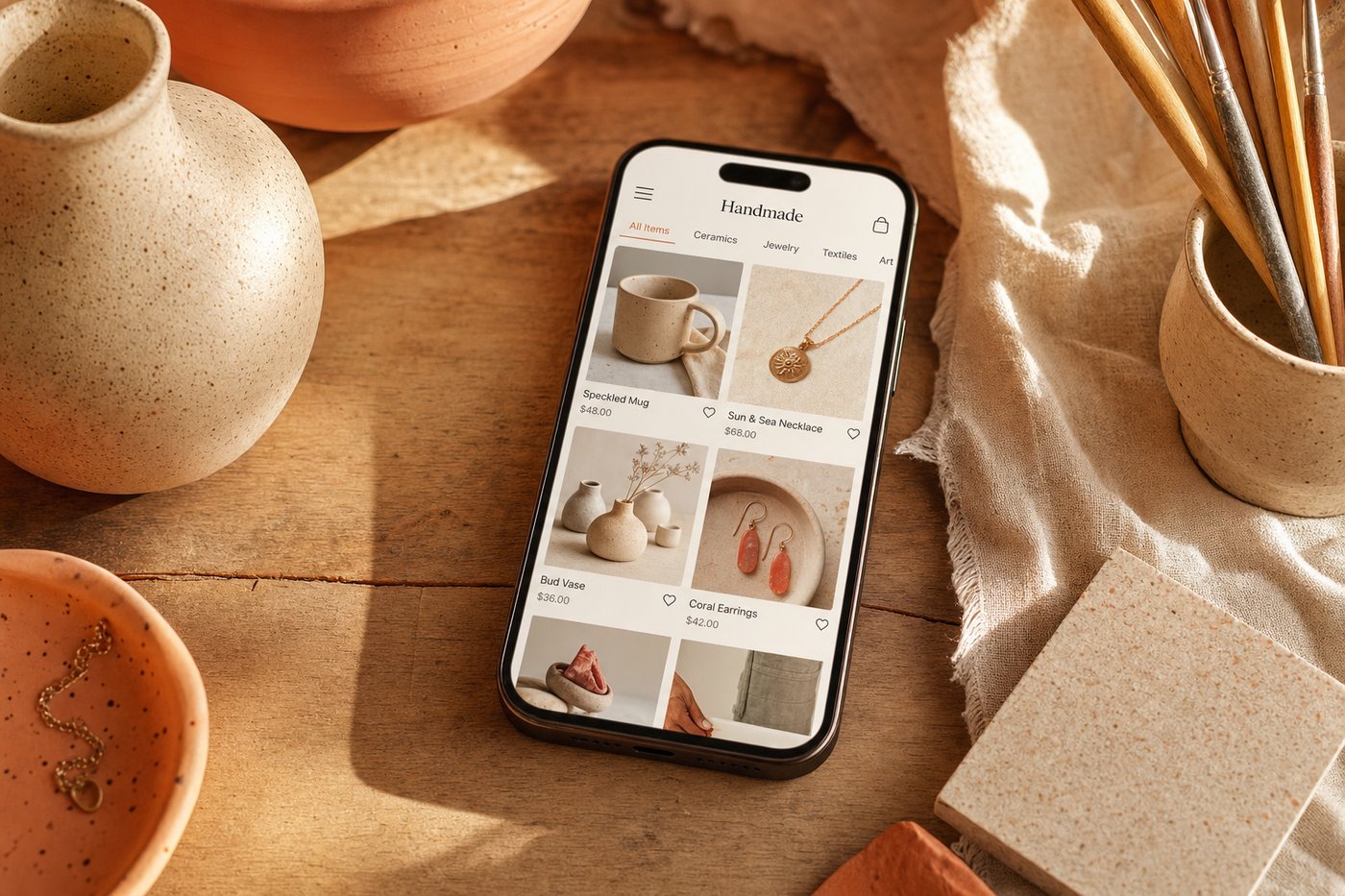
Shopping for something handmade used to mean finding a local craft fair, knowing the right person, or hoping a specialty store happened to carry what you were looking for. Now it means opening a phone and choosing between two very different visions of what a handmade marketplace should be. Etsy is the specialist: a platform built from the ground up around independent makers and vintage sellers, with a culture and community that takes craft seriously. Amazon Handmade is the generalist's answer: a curated section within the world's largest store, bringing Amazon's logistics network and customer base to artisan sellers who want to reach more people without building their own presence from scratch. Which one deserves your attention — and your dollar — depends on what kind of shopper you are and what you're actually looking for.
At a glance
- Etsy — founded Brooklyn 2005; global marketplace for handmade, vintage, and craft supplies; 45 million items currently listed; 1.9 million active sellers; 31.7 million active buyers; consumer app rated 4.9/5 from 57 million App Store ratings; desktop and mobile experiences tuned for browse-and-discover shopping; supports image search, gift lists, and occasion-based discovery.
- Amazon Handmade — launched October 2015 as a curated section within Amazon's marketplace; sellers must apply and be verified as artisans by Amazon before listing; no separate app required — products are accessible through the standard Amazon Shopping app and website; leverages Amazon's Prime shipping network, review infrastructure, and A-to-Z buyer protection.
- Key difference — Etsy is a purpose-built platform with its own discovery tools, seller community, and culture around handmade and vintage goods; Amazon Handmade is a product category within Amazon that trades on Amazon's scale and logistics, with a narrower and less browsable selection of verified artisan items.
Setup & onboarding
For buyers, Etsy requires an account (or sign-in via Google or Apple ID) and a payment method. Guest checkout is available for one-off purchases. The app is available on iOS and Android with an experience designed around exploration: image-based search that recognizes visual style and aesthetics, curated gift guides organized around occasions and recipient types, and a favorites and collection system for saving items you're considering. The Etsy app's discovery surface is its most distinctive strength — you don't always arrive knowing exactly what you're looking for, and the platform is designed to accommodate that. Personalized recommendations based on browsing history refine over time, improving as you use the platform.
Amazon Handmade requires no separate setup beyond an Amazon account. If you already shop on Amazon — and the vast majority of US online shoppers do — you access Handmade through the Amazon app's search, dedicated Handmade storefront, or through category filters on existing search results. Checkout uses your existing Amazon payment and shipping details, which for Prime members means one-click purchasing without re-entering any information. This zero-friction entry is Amazon Handmade's clearest structural advantage for buyers already embedded in the Amazon ecosystem. There is nothing new to learn, download, or set up.
Speed & checkout experience
Amazon Handmade's checkout experience mirrors Amazon's standard flow, which is among the fastest in e-commerce for returning Prime customers. One-click ordering works where available. Prime shipping on eligible Handmade listings can deliver in two days or sometimes same-day in major markets. For buyers who prioritize shipping speed and the certainty of Amazon's logistics network, this is a difficult advantage for any other marketplace to match.
Etsy's checkout is clean and well-designed, accepting major credit cards, PayPal, Apple Pay, Klarna, and Etsy gift cards. But delivery timelines on Etsy vary significantly by seller and product type. A custom, made-to-order item might take two to four weeks to reach you — that's inherent to bespoke craft, not a platform failure. Ready-to-ship inventory can arrive in a few days from domestic sellers, which narrows the gap with Amazon Handmade for non-custom purchases. The Etsy app's order tracking and direct seller messaging tools help buyers stay informed during longer production windows, and communication between buyers and makers is a core part of the Etsy experience in a way it rarely is on Amazon.
Security & privacy
Both platforms encrypt payment data and support two-factor account authentication. Amazon's fraud detection infrastructure is among the most sophisticated in e-commerce — a function of its scale and volume of transactions. Amazon's A-to-Z Guarantee covers eligible purchases from third-party sellers, including Amazon Handmade listings, providing buyer protection if an item doesn't arrive or doesn't match its description. This is a meaningful safety layer for buyers purchasing from individual artisans they've never transacted with before.
Etsy's Purchase Protection program also covers buyers when an item doesn't arrive or significantly differs from the listing, and Etsy's seller rating and review system provides pre-purchase signals about a seller's reliability. Both platforms' protections are adequate for typical purchases; neither is significantly riskier from a buyer protection standpoint.
On privacy: Etsy's data collection is focused on its own platform ecosystem — purchase history, browsing patterns, and search behavior within Etsy's interface. Amazon's data collection is more extensive and spans its broader network of services and advertising products. For privacy-conscious shoppers, the narrower scope of Etsy's data practices may be a meaningful consideration. Our shopping app privacy guide covers what each type of platform collects.
Costs & fees
Etsy — completely free for buyers. Sellers pay a $0.20 listing fee per item, a 6.5% transaction fee on the sale price (including shipping), and standard payment processing fees. These costs are often visible in slightly higher per-item prices compared to what the same seller might charge on their own website, but they are standard for marketplace economics and are offset by the traffic Etsy provides sellers who would otherwise need to build their own audience.
Amazon Handmade — free for buyers (standard Amazon account). Sellers in Handmade pay a 15% referral fee to Amazon, waived for some categories during certain periods as Amazon has used fee incentives to attract Handmade sellers. Prime membership at $14.99/month is effectively required to get the full benefit of Amazon Handmade's logistics advantages — fast shipping is Prime's main draw for Handmade buyers. Without Prime, Amazon Handmade purchases ship at standard speeds that may not be significantly faster than Etsy's ready-to-ship inventory.
Where each one wins
Etsy wins on: the sheer depth of handmade and vintage inventory across categories, seller community and culture (sellers who care deeply about their craft and communicate directly with buyers), the quality of its discovery tools for finding items you didn't know you were looking for, custom and personalized item availability, and vintage goods selection that Amazon Handmade doesn't replicate. If you're looking for something genuinely unique — a custom ceramic mug, a hand-carved wooden toy, a specific mid-century vintage piece — Etsy's depth of specialist sellers is the right starting point. Our full breakdown is in the Etsy app review.
Amazon Handmade wins on: Prime shipping speed for eligible listings, Amazon's A-to-Z buyer protection as an explicit guarantee layer, the convenience of a single Amazon account for handmade and non-handmade purchases in the same checkout, and the familiarity of Amazon's interface for shoppers who find Etsy's style-forward design less intuitive. For buyers who occasionally want something handmade and want Amazon's logistics and buyer protection behind it, Handmade is a reasonable entry point.
For broader Amazon shopping context, see our Amazon Shopping app review. Our full best shopping apps 2026 list includes rankings across both platform types.
Seller experience and how it shapes what you buy
This is a dimension that buyers often overlook, but it shapes the marketplace in ways that matter. Etsy's sellers are independent makers and vintage curators who chose Etsy specifically because of its audience of handmade-interested buyers. The platform's culture of direct seller-buyer communication, personal shop pages with backstory and process documentation, and the ability to request custom variations of items are all functions of a marketplace designed around the relationship between the person who made something and the person buying it. When you message an Etsy seller, you're usually talking to the person who will make your item. That directness has real value for custom purchases.
Amazon Handmade's sellers are also genuine artisans — the application and verification process is meant to ensure that — but the selling environment is Amazon's: product-focused, review-centric, optimized for discoverability within Amazon's search algorithm rather than for storytelling or direct buyer relationships. The experience of browsing Amazon Handmade feels more like browsing any other Amazon category than like exploring a marketplace of makers. That's not necessarily a flaw — for buyers who prefer the Amazon format — but it is a different experience, and for many handmade shoppers, the relational dimension of Etsy's marketplace is part of what makes it worth using. The seller experience bleeds through into the buyer experience in ways that are difficult to quantify but easy to feel after a few purchases on each platform.
Bottom line
Etsy and Amazon Handmade serve overlapping but meaningfully different audiences. If handmade and vintage shopping is a regular part of your life — if you care about the maker, the story behind an item, the ability to communicate directly with the person who made what you're buying — Etsy is the platform that was built for you. Its inventory is deeper, its discovery tools are richer, and the community around it reflects decades of investment in a specific culture. If you want something handmade and you want Amazon's logistics confidence and existing account convenience, Amazon Handmade is a reasonable option, though its selection is narrower and less browsable.
The practical conclusion for most handmade shoppers: start with Etsy for the shopping experience and the depth of inventory. Check Amazon Handmade if you need fast shipping on a specific type of item and find what you're looking for there. The two platforms are not mutually exclusive, and for different shopping missions they each make sense. What they don't do is replace each other.